Helping Kids – Stay Calm When Things Aren’t Perfect – Confidence vs. Perfectionism (Series #4)
Quick Summary about Helping Kids Stay Calm
- Many kids in Miami struggle with perfectionism because of school pressure, bilingual expectations and fast routines.
- Perfectionism is not confidence — it is fear disguised as effort.
- Children can learn to stay calm, flexible and confident even when things don’t go as planned.
- This guide shows parents simple steps to reduce pressure and build real self-confidence.
Table of Contents
- 1. The Difference Between Confidence and Perfectionism
- 2. Why So Many Kids Become Perfectionists
- 3. Signs Your Child Is Stuck in Perfectionism
- 4. How to Build Real Confidence Instead
- 5. Tools Kids Can Use to Stay Calm
- 6. Support in Miami
1. The Difference Between Confidence and Perfectionism
At first glance, perfectionism can look like motivation: neat handwriting, strong effort, high responsibility. But emotionally, perfectionism is rooted in fear — fear of making mistakes, fear of disappointing others, fear of not being “good enough.”
Confidence, on the other hand, means:
- trying even when something feels hard
- accepting mistakes as part of learning
- recovering quickly from setbacks
- believing “I can figure this out”
When kids build real confidence, they become more flexible, more resilient and calmer in daily life.
2. Why So Many Kids Become Perfectionists
In Miami, kids often grow up between languages, cultures and high academic expectations. Add after-school activities, homework, competition and social comparison — and suddenly many children feel they must perform at 100% all the time.
Perfectionism develops when a child believes:
- “If I make a mistake, something bad happens.”
- “My worth depends on how well I perform.”
- “I must be the best to feel safe.”
Kids don’t choose perfectionism — it grows silently through pressure.
3. Signs Your Child Is Stuck in Perfectionism
Common signs include:
- frustration or tears when tasks aren’t perfect
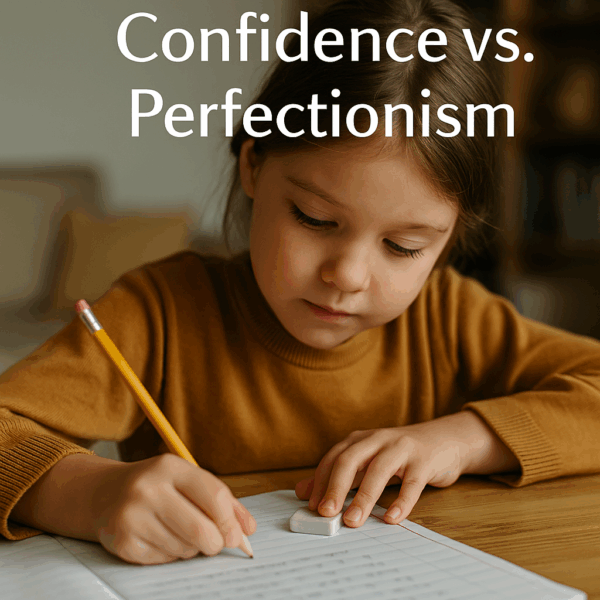
- erasing work repeatedly until the page tears
- fear of trying new things or asking questions
- extreme self-criticism (“I’m bad at this”)
- avoiding tasks that feel difficult
- needing constant reassurance
4. How to Build Real Confidence Instead
1. Celebrate effort, not outcomes
Say: “I love how you tried,” instead of “You did it perfectly.”
2. Model mistakes at home
When parents say, “Oops, I made a mistake, let me fix it,” kids learn that mistakes are normal.
3. Ask growth-focused questions
Try: “What did you learn from this?” instead of “Why is this wrong?”
4. Break big tasks into small steps
A calm nervous system helps confidence grow naturally.
5. Reduce hidden pressure
Kids sometimes hear pressure even when parents don’t mean it. Softening tone and expectations helps them relax.
5. Tools Kids Can Use to Stay Calm
- Two-Minute Breathing Break: inhale for four, exhale for four — repeat.
- Grounding Technique: name one thing you see, hear and feel.
- “Good Enough” Rule: some tasks don’t need perfection — just completion.
- Confidence Anchor: a small gesture linked to a positive memory.
These tools help kids shift from pressure to presence — especially during school, homework and performances.
6. Support in Miami
If you notice perfectionism affecting your child’s confidence or mood, emotional coaching can help them build resilience and calmness step by step.
Email: coachingkids@bayardcoaching.com
WhatsApp: 305 338 1786
Sessions available in Doral, Kendall and online.
